Research
I study the interior structure and evolution of solid planetary bodies.
Page contents
Mercury
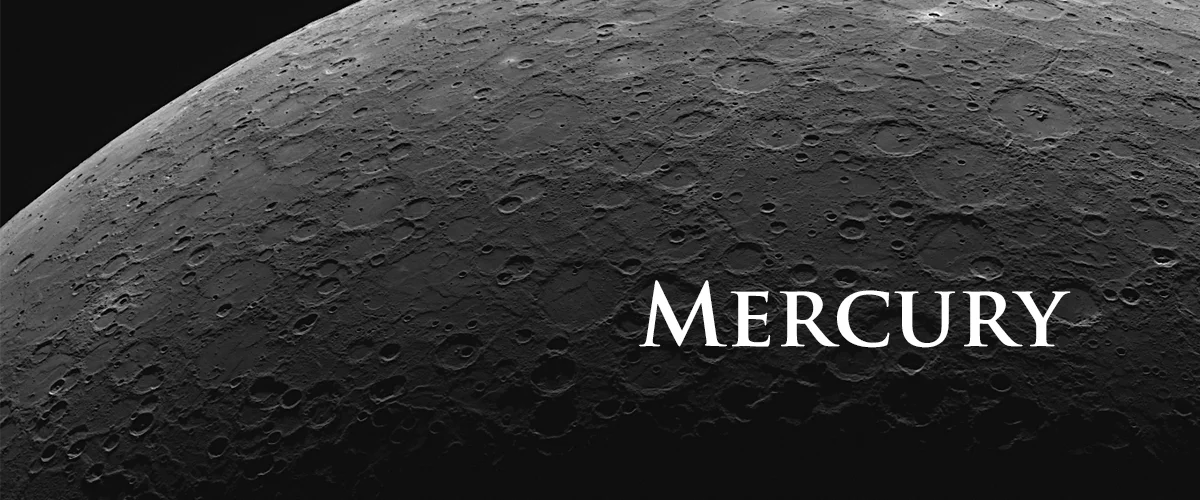 Image credit: NASA/JHUAPL/CIW
Mercury is the smallest planet and the closest to the Sun. Its gray, heavily cratered surface resembles that of the Moon, but its interior is very different. Whereas the Moon is composed mostly of rock, Mercury consists mainly of metal (primarily iron), with only a thin rocky layer covering its surface. A closer look at this rocky portion reveals that its elemental composition differs from that of the Moon and other terrestrial planets. Investigating the interior structure, origin, and evolution of this unusual planet is expected to shed light on the early evolution of the inner Solar System and on the processes of rocky-body accretion.
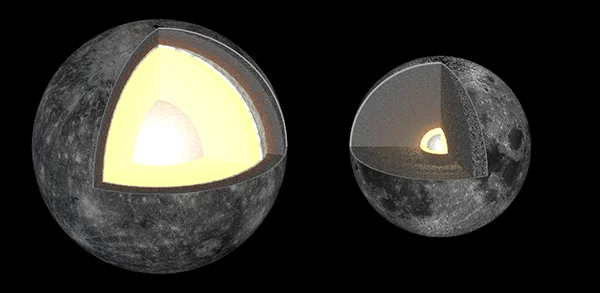
One key to probing Mercury's interior is its tidal response. Because Mercury has no surface ocean, it is the solid surface itself—rather than sea level—that rises and falls with the tide, changing the planet's oblateness (the degree to which a sphere is flattened). This tide-induced change in oblateness produces a corresponding change in the oblateness of the gravity field, which has been detected through precise tracking of spacecraft: this is the tidal response of the gravity field. As an Interdisciplinary Scientist (IDS) for the ESA/JAXA Mercury mission BepiColombo, I am investigating what interior structure—in terms of composition, temperature, and so on—can reproduce the observed tidal response of Mercury's gravity field.
The Moon
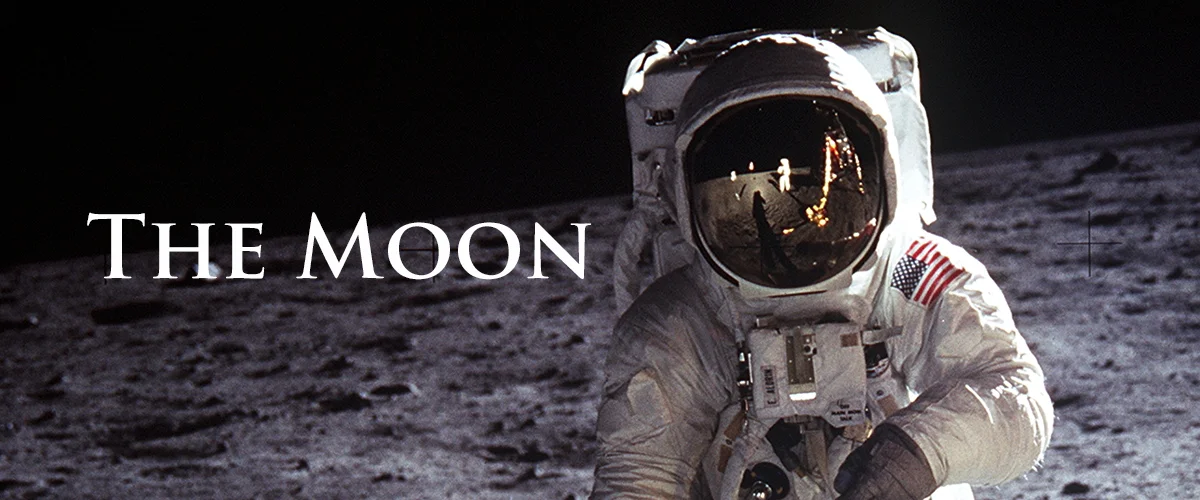 Image credit: NASA
The Moon is the closest planetary body to Earth and has been studied extensively, providing a wealth of observational data. Because it lacks an atmosphere and oceans, the Moon has experienced no weathering or erosion, and geological features that are billions of years old are thought to remain clearly preserved. As a simpler system than Earth, the Moon offers an ideal setting for understanding the early evolution of planets.
As one key to unraveling thermal evolution—the most fundamental process in planetary evolution—I focus on the long-term deformation of impact basins, the enormous craters left by large impacts. If the interior was hot at the time a basin formed, viscous relaxation would have proceeded and the crust should now be flat. If instead the subsurface was very cold, relaxation would not have occurred, and the concentric structure created by the impact should still be visible today. In fact, roughly half of the Moon's impact basins are almost fully relaxed, while the concentric structure of the remaining half is still clearly visible.
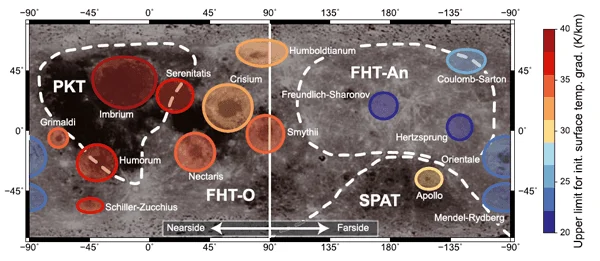
By comparing topographic and gravity field data obtained by the Kaguya (SELENE) lunar explorer with the results of relaxation calculations from a range of thermal evolution models, we constrain the interior temperature structure at the time basins with preserved concentric structure formed. This constraint on past temperatures also allowed us to place limits on the abundance of radioactive elements in the subsurface—an important result, since the heat released by their decay is a major heat source driving planetary evolution.
Using data from LRO and GRAIL as well, we further clarify the relationship between the basin formation ages and the solidification of the lunar magma ocean. Building on these results, we are now studying the history of large impacts across the Solar System.
Asteroids
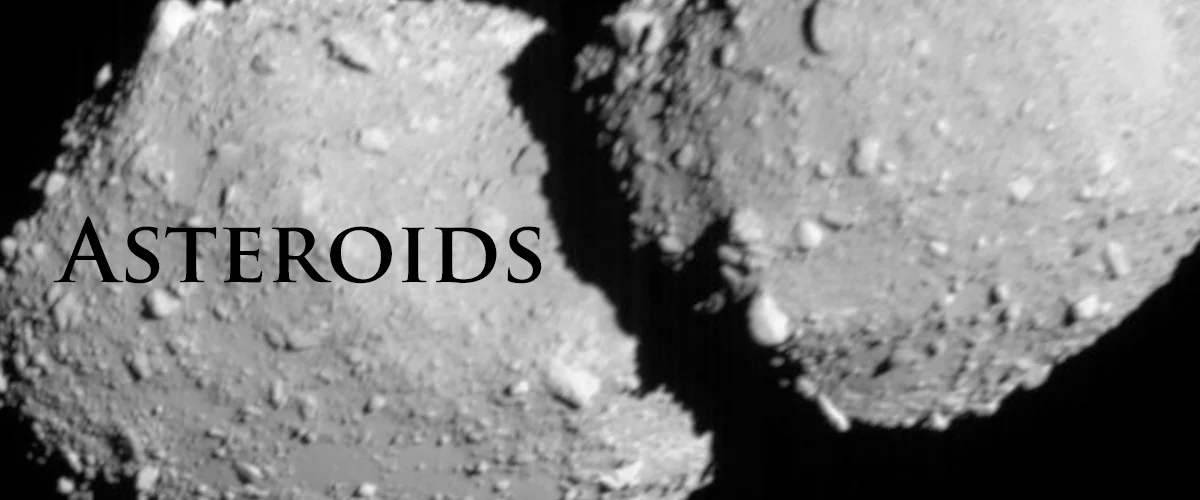 Image credit: JAXA, U. Tokyo & collaborators
The Solar System contains countless asteroids. Most reside in the asteroid belt between the orbits of Mars and Jupiter, but many others orbit close to Earth. These are known as near-Earth asteroids, and they attract attention both for their scientific interest and, from a planetary-defense perspective, as potential hazards.
One spacecraft investigating near-Earth asteroids is JAXA's Hayabusa2. For its extended mission, named as Hayabusa2#, I am Principal Investigator of the laser altimeter (LIDAR) carried on board Hayabusa2, an instrument that determines the precise distance between the spacecraft and its target by measuring the time it takes for an emitted laser pulse to return. On July 5, 2026, Hayabusa2 made a close, high-speed flyby of the asteroid Torifune, during which we used LIDAR to measure the distance to the asteroid. This marked the world's first laser ranging performed during an asteroid flyby. Given the technical significance of this achievement, a joint press release was issued by JAXA, Hokkaido University, and the other institutions of the LIDAR team.
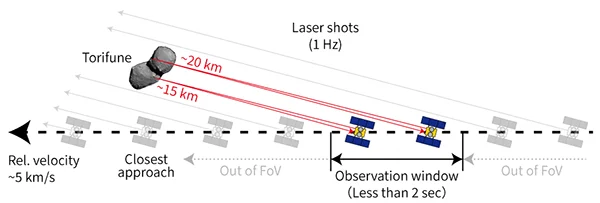
We are now combining LIDAR data with measurements from other instruments to produce scientific results from the Torifune flyby.
Icy Satellites
 Image credit: NASA/JPL/SSI
Beyond the orbit of Jupiter, many icy bodies exist. Most satellites of the giant planets are of this type and are called icy satellites. Beneath the surfaces of icy satellites such as the Jovian moon Europa and the Saturnian moon Enceladus, global liquid layers called subsurface oceans are thought to exist, and understanding how these oceans form and are maintained is one of the key themes in planetary science.
I study the interior structure and thermal evolution of icy satellites, focusing on tidal deformation and tidal heating. Using numerical models that account for the ocean's own dynamics, we show that as a subsurface ocean thins to a certain thickness, tidal deformation can be strongly amplified through resonance. Because this resonance enhances tidal heating, it may serve as an important mechanism for maintaining subsurface oceans over long timescales.
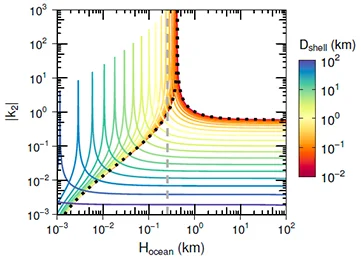
Tides in icy satellites are highly complex. To begin with, a liquid layer lies sandwiched between two solid layers. In addition, seawater likely permeates fractures in the rocky layer beneath the subsurface ocean, creating a layer where solid and liquid coexist. I have been developing a theoretical framework—and the corresponding numerical code—for calculating the tidal response of bodies with such complex interior structures.
I am also studying the role tidal heating plays across satellite systems, taking into account satellite–satellite interactions characteristic of giant-planet systems. In addition, I am participating in future icy-satellite exploration missions such as JUICE, bound for Jupiter's icy satellites, and NASA's Dragonfly mission to Saturn's icy moon Titan, and conducting preliminary theoretical studies toward understanding the interior structure and long-term evolution of their target bodies.
Pluto
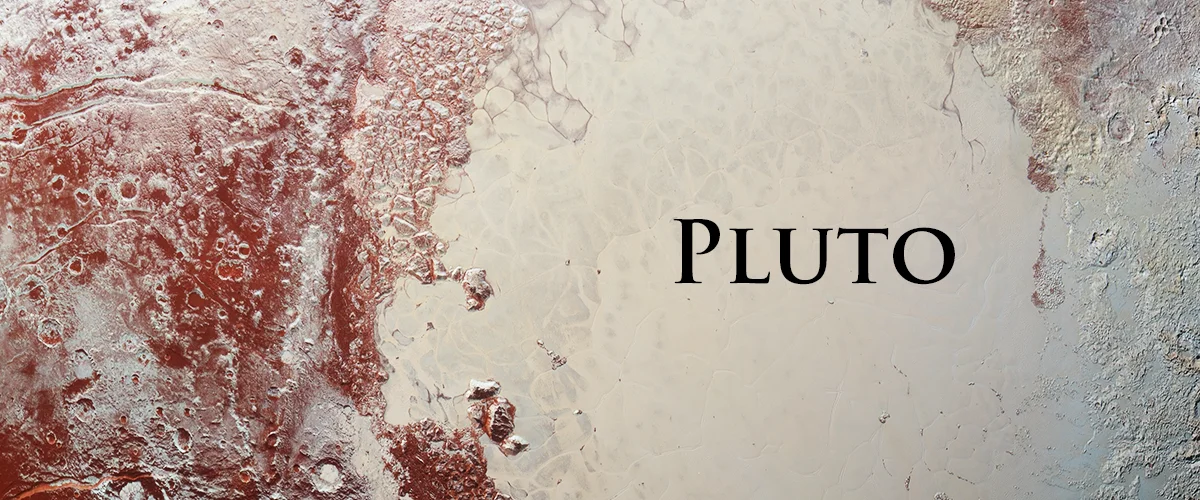 Image credit: NASA/JHUAPL/SwRI
Pluto is a large body located in the Kuiper Belt, the region beyond the orbit of Neptune. Observations by NASA's New Horizons spacecraft deepened our understanding of Pluto while also revealing new mysteries. One is the presence of a thick liquid layer (subsurface ocean) beneath a shell of ice (ice shell); because Pluto lies far from the Sun in an extremely cold environment with little internal heat, its subsurface ocean was expected to have frozen solid long ago. A second mystery is that the ice shell is locally much thinner than expected, since previous studies predicted that such thin regions should flatten out over a short time. A third mystery is that the chemical composition of Pluto's surface differs markedly from that of comets originating in the Kuiper Belt.
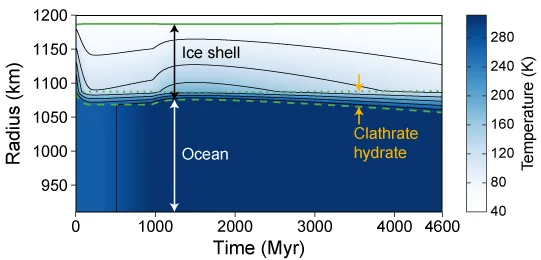
We present a unified explanation for these mysteries. The key is gas hydrates (clathrate hydrates). If a thin layer of gas hydrate exists between Pluto's ice shell and subsurface ocean, it acts as a thermal insulator that keeps the ocean liquid for a long time while allowing the ice shell above to cool and become rigid. We also show that the tendency of gas hydrates to selectively trap certain gases can account for the unusual surface composition.
Through this work on Pluto, we identify a general mechanism for maintaining subsurface oceans. Other icy bodies besides Pluto also meet the conditions for gas hydrate formation, suggesting that gas hydrates may play an important role in maintaining their subsurface oceans as well. Building on this, we are now studying the thermal evolution of large icy satellites.
The press release of this work from Hokkaido University can be found here. This work was selected as a Research Highlight by Springer Nature and was featured by numerous news media outlets. Some examples are listed below.
Media Coverage
Exploration missions
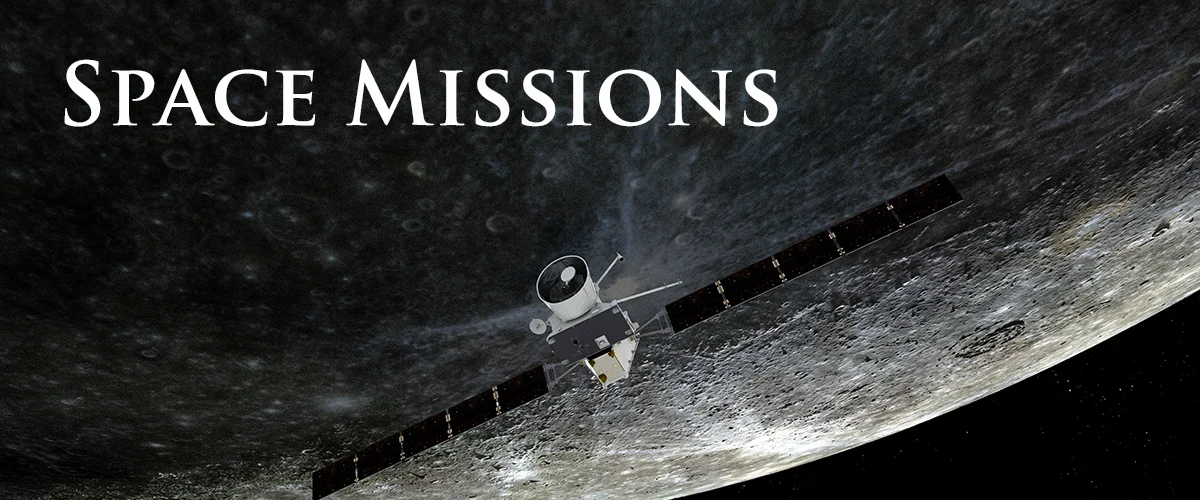 Image credit: ESA/ATG medialab
My research has contributed to a wide range of planetary exploration missions. For JAXA's lunar mission Kaguya (SELENE), I was a member of the RSAT/VRAD gravity science team. My responsibilities included the operation of the relay satellites Okina and Ouna and the analysis of Same-Beam VLBI data used for high-precision lunar gravity field determination.
I currently serve as an Interdisciplinary Scientist (IDS) for the ESA/JAXA Mercury mission BepiColombo, where I contribute to interdisciplinary science activities and promote the scientific exploitation of data from ESA's Mercury Planetary Orbiter (MPO). In April 2026, I hosted the mission-wide Science Working Team meeting at Hokkaido University. For JAXA's asteroid exploration mission, the Hayabusa2 Extended Mission (Hayabusa2#), I lead the LIDAR (Laser Altimeter) team. During the flyby of asteroid Torifune, the instrument successfully performed the world's first laser ranging to an asteroid during a flyby, marking a major milestone in planetary laser altimetry.
I also contribute to several other international planetary missions. I am a Co-Investigator of the Ganymede Laser Altimeter (GALA) on ESA's Jupiter Icy Moons Explorer (JUICE) mission and a member of the Japanese science team, JUICE-Japan. For NASA's Dragonfly mission to Titan, I serve as a Mission Collaborator and as a member of the ISAS/JAXA project team for the DraGMetSEIS seismometer. I am also a Co-Investigator in the Geodetic Science Strategy Team (G-SST) for JAXA's Martian Moons eXploration (MMX) mission and a Science Collaborator for NASA's New Horizons mission.
Furthermore, I contribute to science definition and mission planning activities for future planetary exploration projects, including JAXA's OPENS outer-planet exploration program and the NGSR next-generation small-body sample return mission.